The Capable & Overwhelmed Trap: When Looking Fine on the Outside Means Suffering Inside
From the outside, you look like you have it together. You are capable, reliable, and the one people count on. But inside, you are overwhelmed, exhausted, and quietly running on empty. This is what neurodivergent burnout can look like, especially for women who have learned to mask and carry more than their nervous system was ever meant to hold. If that sounds familiar, you are not alone, and you are not broken.
By Laura Zane, LMHC | Sage Synergy Counseling & Wellness | Online Therapy in Florida
From the outside? You look like you have it all together.
The kids are fed and at school on time (mostly on time, I see you my ADHDers). The house isn’t a total disaster; it’s good enough. You’re showing up to work. You’re keeping the marriage going. A lot of the time, you are the person other people call when things get hard, because honestly, you just seem like you’ve got it together.
This pattern is especially common in neurodivergent women and highly sensitive adults who have learned to mask their struggles while quietly carrying an overwhelming mental and emotional load.
But here’s what nobody sees: you are sinking.
Your meltdowns happen in the shower. They happen during your revenge procrastination bedtime. That sweet quiet time when the house is finally asleep. You KNOW you need to go to bed; instead, you stay up too late and maybe even fall apart. Your downtime is spent sleeping, hoping to recover from the sensory and emotional overload that just never stops. You fantasize about escaping on a solo vacation. Not because you don’t love your family, you absolutely do, but because you are running on empty and you know that a few days alone would mean coming back fuller. More present. More you.
Sound familiar? Welcome to what I call the Capable & Overwhelmed Trap. And yes, I have been there. More on that in a bit.
Neurodivergent Burnout: Why You Feel Fine on the Outside but Overwhelmed Inside
This is something I see all the time in neurodivergent women, especially those with ADHD, autism, or high sensitivity. Women who look like they are functioning well on the outside but are actually experiencing burnout and overwhelm internally.
And the hard part? The more capable you are, the easier it is for this to go unnoticed. By other people. And eventually, by you too.
What Is the Capable and Overwhelmed Trap?
A lot of neurodivergent people, whether that is ADHD, autism, sensory processing differences, anxiety, or some delightful grab bag of all of the above, get really good at masking. Masking is basically learning to perform “normal” in a world that was not designed for your brain. You learn young. You become a masking expert. And eventually it becomes so conditioned, so automatic, that even the people closest to you have no idea how much effort it takes just to get through a regular Tuesday. Hell, sometimes you don’t even realize you have put on the mask!
The Catch 22 is the better you are at masking, the more invisible your struggle becomes. To everyone around you. And sometimes to yourself.
When you look like you have it all together, people assume you can handle more. So more gets added. And because you’ve been doing it so well, it never occurs to most people to ask if you’re actually okay.
Why Women Mask More (Society, We Need to Talk)
Neurodivergent women mask at significantly higher rates than their male counterparts, and that is not an accident.
From the time we are little girls, we are taught to manage other people’s feelings. Be agreeable. Be helpful. Keep the peace. Smile through it. Take care of others. Was anyone else given that stupid JOY message? Jesus, Others, Yourself? Talk about a recipe for burn out! These messages become part of who we are, so much so that many of us do not even notice we are doing it. It just feels like being a good person. A good mom. A good partner. A good employee. And, society rewards us for it.
But what it actually looks like in practice is a neurodivergent woman who has become so skilled at managing everyone else’s experience that she has completely lost track of her own.
The world taught us to manage other people’s feelings. Nobody taught us to manage our own nervous system. And that gap? That’s where the overwhelm lives.
Layer on top of that a world that was not built for neurodivergent brains, and you have a very exhausted, very masked, very burnt out woman who looks, from the outside, like she is absolutely thriving.
The “What If” Gap: Why Neurotypicals Don’t See What You See
Here is something that might help you feel a little less alone in the resentment spiral: neurotypical people are generally not the ultra deep thinkers. They are not going seven layers deep when they ask you for something.
When they ask for help, they are not thinking: “If she says no, who will do this? She only asks when she really needs it so she must really need it. I can’t leave her without support. What if something goes wrong? What if she thinks I don’t care?”
They are thinking: “I need help. She’s good at this. I’ll ask.” That’s it. No seven-layer dip of consequences and contingencies.
But your brain? Your brain is already running all the scenerios before you can even answer. You are calculating their emotional reaction, your own guilt, the litany of what-ifs, and three different worst case possibilities, all at the same time. That is not a flaw. That is a highly empathic, pattern-seeking brain doing what it does. But it is also an enormous amount of invisible labor that neurotypicals simply do not carry, and often do not even know to account for.
They asked a simple question. You answered a 47-question internal exam. No wonder you’re exhausted.
And Then There’s Menopause (Nobody Warned Me About This Part)
Okay can we talk about this? Because I feel like it does not get said enough.
Before menopause, things were hard. During menopause? I was a walking train wreck that forgot even where the tracks were.
And I want you to know…if you are in perimenopause or menopause and everything has suddenly gotten louder, harder, more overwhelming, and somehow more intense all at once, you are not imagining it and you are not losing your mind!
Here is what is actually happening: estrogen does a lot of behind-the-scenes work for your brain. It supports executive function, helps regulate your nervous system, and plays a role in how you process sensory input and emotions. TADA! Enter peri-menopause: hormones starts going haywire, everything that was a little hard becomes impossible. The ADHD symptoms you had mostly figured out? Back like a bad fungus in the middle of a rain forest. The sensory sensitivities you had learned to work around? They amplify like an 80’s rock concert. Sleep falls apart. Anxiety spikes. The masking that you didn’t realize your were doing…becomes almost impossible.
A Confession (Or: The Day Three Clients All Showed Up for the Same Appointment Time and I Wanted to Disappear)
Okay. Storytime. And I am sharing this because I think it will make you feel better about literally any scheduling mistake you have ever made.
About a year into my private practice, I was an overbooked, overwhelmed, mom with an infant practice running on fumes, and doing that very thing I talk to clients about, taking on more than my nervous system could actually handle.
Client One was a regular. She called to schedule, we set her up for my 10 am appointment, and then I got distracted (hi, ADHD) and forgot to add it to my calendar. She showed up. I had completely forgotten, because typical ADHD, out of sight, out of mind.
Client Two was a new client. She called, I booked her for 10 am, same time as client One. Apparently, between booking the appointment and crying kids, I got pulled away before I could record it.
Day of, Client Three called in crisis. I had to get her in immediately. Cool, I love how Divine works things out…I have a 10 am open.(You see where this is going right?) I was like come on in.
The first one to show was my crisis client. As she is crying I hear the door open and close. Huh, that is weird, my office mate doesn’t usually work Thursdays. I go out and it was my regular. I was like oh no, I am so sorry, I double booked. Go back, work with the crisis client, in walks my new client. I check to see if she is there for my office mate, NO, I am here for you. I was mortified. I felt like a terrible therapist. Like I had failed people at the exact moments they needed reliability most. Enter self-criticism .
But here is the truth: I was not a bad therapist. I was an overwhelmed therapist who had taken on too much and had absolutely zero systems in place to compensate for my brain’s very predictable weak spots.
The fix was not to try harder or be more careful or give myself a stern lecture about being more organized. The fix was self-scheduling software, so the system does what my brain was never consistently going to do on its own. Simple. Practical. Genuinely life changing.
The “Just Say No” Problem (It Is Not That Simple)
“Just say no!” Oh, cool. Thanks. Super helpful. Why did none of us think of that? Insert eye roll here.
Here is what actually happens: someone asks you to do something. Your nervous system is already maxed out and you do not process that fast enough in the moment. (Remember you are not just processing the request, but those 47 internal questions) Panic and overwhelm set in. So you say yes. Then later, when you’ve had actual time process all the pieces, you realize: oh no, I have overcommited.
Then, you have to go back and say…well actually…I thought I could, but… (which, by the way, is a sign of self-awareness, not flakiness), you are often met with annoyance or frustration. Cue: people-pleasing, rejection sensitivity, self-doubt or trauma history triggers around disappointing people.
A lot of us also have the urge to over-explain. We think: If I just give them enough context, they will understand and they will not be upset. What actually happens is the more you explain, the more others who are used to you being there, begin to negotiate. Suddenly you are stuck in a conversation your nervous system did not sign up for, you cannot think fast enough to find the exit, and you say yes again. And then the spiral: resentment, self-criticism, shame. Why can I never just say no? What is wrong with me?
Nothing. Nothing is wrong with you, except that you may need some actual tools.
5 Ways to Say No (Plus a Maybe, Because Sometimes You Just Need a Minute)
Short. Warm. Firm. No novel-length explanation. Here is what works:
“While I’d love to help, I don’t have the energy for that right now.” Honest and human. Energy is a real resource. Yours is limited. That is a complete sentence.
“I can’t prioritize that right now, so I’ll need to decline.” Clean. Professional. Nothing to argue with.
“My time is limited right now, and I can’t. Thank you for thinking of me.” A little warmth without opening the door for negotiation.
“Thank you for thinking of me. I’m not able to help with that.” The sentence ends at “though.” Do not add more. I know you want to. Do not.
“That doesn’t align with my goals right now, so I’m going to pass.” Great for professional settings. Decisive. Forward-looking. Very “I have my life together” energy even when you do not.
And the maybe, for when your brain genuinely needs time to process:
“I’d like some time to consider that. Can I get back to you in 24 to 48 hours?” This is not stalling. This is your brain doing what it needs to do, checking in with your actual capacity instead of defaulting to yes under pressure. Use this one freely and without guilt.
A few extras for the collection:
“I’m at capacity right now.”
“I’m not the right person for this right now.”
“I need to protect my bandwidth this season.”
The Capable & Overwhelmed Trap Is Real and It Is Exhausting
There is nothing small about carrying this much, even if your life looks “fine” from the outside.
When you are used to being the capable one, the reliable one, the one who figures it out, it can be really hard to even recognize how much you are holding, let alone give yourself permission to need support.
It’s okay to say, I need help. I can’t do this alone anymore.
That is often where things begin to shift.
Learning to protect your nervous system, say no without the guilt spiral, stop masking your way into burnout, and build a life that actually works with your brain rather than against it, these are all things you can genuinely work on. And when you do, the shift is real. Not just for you, but for everyone around you.
Because a you that is actually resourced is so much more present than a you that is white-knuckling through every single day. Your family does not need you to look fine. They need you to actually be okay.
If you are ready for support, we can work together in therapy to help you understand your capacity, reduce overwhelm, and build a life that actually works with your brain. I provide online therapy throughout Florida, including Miami, Naples, Tampa, Sarasota, Bradenton, Lakewood Ranch, Palm Beach, Boca Raton, and Orlando.
And if you are not quite ready for therapy, but you know something needs to change, you can start smaller. I have a boundaries course that walks you through how to protect your time, energy, and bandwidth in a way that actually sticks, without burning yourself out in the process.
FAQ’s
Questions I Hear All the Time (You Are Not Alone in These)
Is it normal to feel more overwhelmed than other people even when my life looks fine from the outside?
A: Yes—well, neurodivergent normal. Our brains process sensory input, emotional information, and everyday demands more intensely than neurotypical brains. What looks manageable from the outside can be genuinely exhausting from the inside. You are not being dramatic or too sensitive. You are not weak. You are running a very different operating system in a world that was designed for a different one.
Why do I always say yes and then immediately regret it?
A: So common, especially for people with ADHD or trauma histories. Many neurodivergences come with executive processing issues, which can cause delayed processing. That means your brain cannot always assess your real capacity when pressure is applied—you know, like when you feel people want an answer “NOW.”
Rejection Sensitive Dysphoria means the fear of disappointing someone can override logic instantly. You say yes before your nervous system has even been consulted. The regret shows up later, when the pressure is off and reality has a chance to land.
I think I might be in perimenopause. Could that be making my ADHD or anxiety worse?
A: Almost certainly yes. Estrogen supports executive function, emotional regulation, and how your brain manages sensory input. As it fluctuates during perimenopause, a lot of neurodivergent women see their symptoms ramp up significantly.
Many gifted women get what I call an “ultra late” diagnosis in their 40s or 50s because the hormone changes interfere with their coping skills and ability to mask. If things that used to feel manageable suddenly feel impossible, that is worth exploring with both a therapist and a knowledgeable medical provider. And no, you are not just “getting worse.” Your baseline changed. That matters.
I live in Miami, Naples, Tampa, or Palm Beach and cannot find a therapist who actually understands neurodivergence. What do I do?
A: This is exactly why I offer online therapy throughout Florida. You do not have to choose between finding someone who genuinely understands neurodivergence and finding someone who is available in your area.
We can work together from wherever you are, whether that is a quiet corner of your house in Boca Raton, your parked car on your lunch break in Naples (no judgment, we have all been there), or the one room in your house with a door that locks.
Like this topic and Want More? Check out these blogs.
Buy the precut Watermelon is about choosing less to reduce anxiety and overwhelm and get more out of life.
Burnout In Highly Sensitive women is about being a neurodivergent woman while homeschooling.

You Work From Home — How Do You Have Work Besties?
You Work From Home — How Do You Have Work Besties?
“You work from home… how do you have work besties?”
That’s what my husband asked me after I got back from a local networking event.
He said it with genuine curiosity, not sarcasm.
And it got me thinking.
There’s this assumption that if you work from home, especially as a therapist or healer, you’re sitting in a room by yourself, slowly spiraling into professional isolation. But for me, the truth is quite the opposite….
Returning home from a Saturday networking event, excited and in full ADHD chatter about how much fun I had, how I really enjoyed doing this event with one of my work besties, lost in the dopamine hit as only a true ADHDer can be, I was interrupted by my husband:
“You work from home… how do you have work besties?”
He said it with genuine curiosity, not sarcasm.
Screeched to a halt came the dopamine excitement, and the excitement of the networking train of thought, a sudden shift of tracks….
OH that’s right, I have a whole world that is not in my everyday life, yet a part of my everyday life. Maybe it’s time to talk about that!
There’s this assumption that if you work from home, especially as a therapist or healer, you’re sitting in a room by yourself, slowly spiraling into professional isolation. But for me, the truth is quite the opposite.
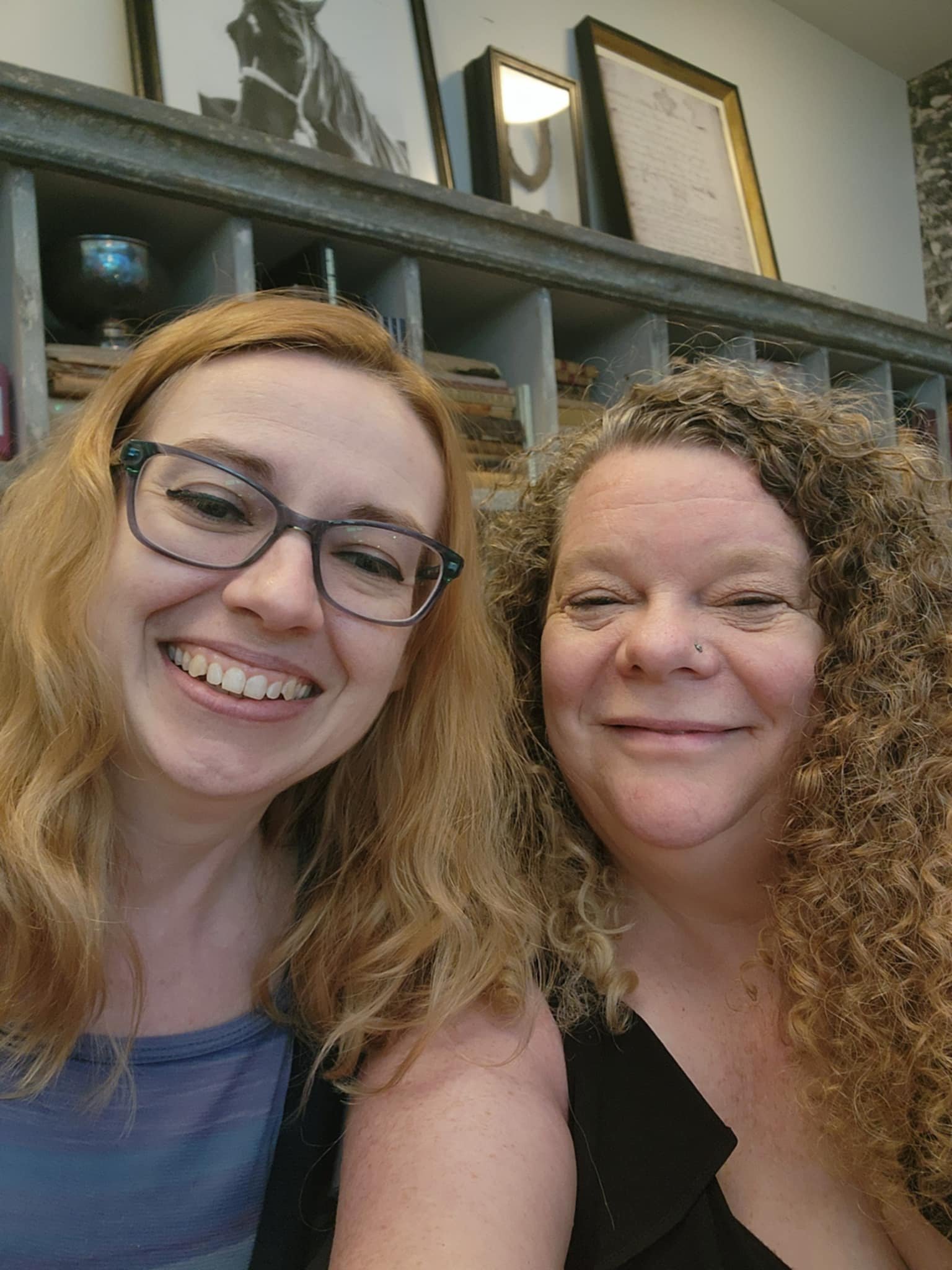
My Bestie Brie-Anna Willey from Business for Nerds find her @https://www.businessfornerds.com/
I Have Work Besties — They Just Don’t All Live Here (well some do, but most don’t)
I have several work besties, and they live all over the country.
Some of them, I’ve never met in person — we found each other online through coaching programs, collaborations, or even social media threads that turned into real friendships.
Others are local — we’ve met for coffee now and then — but most of our connection happens online. We hop on Sunday Zoom calls, check in by voice note, and co-work in real time, from wherever we are.
These relationships? They’re real.
They’re intentional.
And they’re saving me from burnout.
I Was Afraid Going Online Would Be Lonely
As a therapist, I need connection with others who understand what this work takes — emotionally, mentally, energetically.
I used to think working online would strip that away. That I'd be trading connection for convenience. But then I watched my kids build real friendships online — deep, trusting ones. They’d laugh, support each other, and build community in Minecraft or Discord the way I used to at lunch tables and break rooms.
And I thought… why not me?
Online Friendships Can Be Deeper Than In-Person Ones
And honestly? I prefer these relationships to many I had in past in-person jobs.
Back then, we connected mostly because we showed up at the same office. Now, my work besties are people I chose. People who chose me.
We make time to meet — not because we’re forced into the same break room — but because we value each other’s support. We bounce around ideas, talk marketing and mindset, cry, laugh, vent, and get each other through the weirdness that is online entrepreneurship.
They’ve seen me in every state:
Polished and put-together before a presentation
Disheveled and under-caffeinated on a Sunday brainstorm call
Fragile after a tough week with clients
Buzzing with excitement after a big win
These people get me — my work, my energy, my mission. They challenge me…to grow, confront my fears, to TALK about my money challenges.
Neurodivergent Folks Often Prefer This Way of Connecting
I work with many neurodivergent and highly sensitive women, and let me tell you — this kind of connection works for us.
We don’t always thrive in noisy mixers or drop-in groups full of surface-level small talk, it’s exhausting and often feels like we are pushing against our natural desire to go deep fast. We CAN do it, it just leaves us depleted and takes a lot of our spoons.
We like the slow burn of connection — repetitive, intentional interactions that help us decide if someone is safe, aligned, consistent.
And when we do connect around shared goals or mutual understanding?
We skip the water cooler and dive into the deep end.
So Yes — I Have Work Besties
I never imagined going online would grow my sense of community. But it did.
My work besties are a lifeline. A mirror. A brain trust. A nervous system regulation squad.
If you’re thinking about going online — whether as a therapist, coach, healer, or creative — I want you to know that isolation doesn’t have to be your fate.
With a little intention, you can build the community you need.
You can find your people.
You can create meaningful connection — even from your kitchen table in pajama pants.
One More Thing
If you’re sitting in your home office wondering if you’ll ever find your people, consider this your nudge.
✨ Start a conversation.
💛 Join that group.
🌱 Say hi to someone new at the next Zoom event.
Your future work bestie might be one message away.
Frequently Asked Questions
Can online work friendships be as meaningful as in-person friendships?
Absolutely. Meaningful friendships are built through trust, consistency, vulnerability, and shared experiences, not physical proximity. Many people find that online friendships become just as deep, and sometimes even deeper, because they're based on shared values and intentional connection rather than simply working in the same building.
Why do online friendships feel easier for some neurodivergent people?
Many neurodivergent people prefer connection that develops gradually through shared interests and repeated interactions. Online spaces often reduce the pressure of loud environments, small talk, and social expectations, making it easier to build authentic relationships at a comfortable pace. Rather than being forced into conversations because of proximity, online friendships often grow because of shared interests, mutual respect, and genuine choice.
Can working from home lead to isolation?
It can, but it doesn't have to. Working remotely requires being intentional about creating community. Joining professional groups, attending virtual networking events, participating in mastermind groups, scheduling coworking sessions, or simply checking in with colleagues can all help reduce isolation and build meaningful connection.
How can I make friends while working remotely?
Start by participating in communities centered around your interests or profession. Join Facebook groups, attend virtual events, participate in coaching programs, comment on posts, or simply reach out to someone whose work resonates with you. Many lasting friendships begin with one genuine conversation.
Are online friendships "real" friendships?
Absolutely. Research has shown that online friendships can provide emotional support, belonging, and meaningful connection comparable to in-person relationships. Like any friendship, what matters most is trust, consistency, vulnerability, and showing up for one another over time.
I'm highly sensitive and networking events exhaust me. What are other ways to meet people?
Many highly sensitive and neurodivergent people find they connect more naturally through smaller communities, shared interests, coworking sessions, book clubs, mastermind groups, online classes, or ongoing programs where relationships have time to develop naturally. You don't have to force yourself into environments that leave you depleted in order to build meaningful friendships.
Can online friendships help prevent burnout?
For many therapists, entrepreneurs, coaches, creatives, and remote professionals, yes. Having trusted colleagues to celebrate successes, process challenges, exchange ideas, and remind you that you're not alone can reduce isolation and become an important source of emotional support. Sometimes a quick Zoom call with someone who understands your work is exactly what your nervous system needs.
What if I'm naturally introverted?
Being introverted doesn't mean you don't need connection. It often means you prefer fewer, deeper relationships over frequent social interaction. Online communities can make it easier to build those relationships in ways that feel authentic, intentional, and sustainable.
Is it okay if my closest work friends live across the country?
Absolutely. Friendship isn't measured by geography. It's measured by trust, authenticity, and the willingness to show up for one another. Some of the deepest relationships are built not because people share an office, but because they share values, encourage one another's growth, and intentionally choose to stay connected. In many ways, those relationships can become even stronger because they're built on who you are, not simply where you work
How do I know I've found "my people?"
For me, it's less about finding people who agree with everything I say and more about finding people who make it safe to be fully myself. The right people challenge me, celebrate my wins, support me through setbacks, and leave me feeling energized rather than depleted. You don't have to settle for relationships built on convenience. Sometimes the people who understand you best are the ones you intentionally choose, no matter where they live.
Is it normal to feel guilty for preferring online friendships?
Yes. Many people have been taught that "real" friendships have to happen in person. But meaningful relationships are built through mutual care, consistency, and emotional safety, not zip codes. If your online friendships leave you feeling more connected, understood, and supported than many of your in-person relationships, there's nothing wrong with embracing that.
Can online friendships improve mental health?
They can. Feeling understood, supported, and connected is one of the strongest protective factors for emotional well-being. While online friendships aren't a replacement for professional mental health care when it's needed, they can reduce loneliness, provide encouragement, and remind us that we're not navigating life or work alone.
❤️ Final Thought
Whether your work besties live next door or across the country, meaningful relationships are built intentionally. Sometimes the people who help us grow, laugh, challenge us, and remind us who we are aren't sitting in the next office. They're one message, one Zoom call, or one "I saw your post and just wanted to say hi" away.
Because belonging isn't about proximity.
It's about finding people who feel like home.

Burnout in Highly Sensitive Women: Motherhood, Homeschooling, and Learning to Choose Less
Burnout is real, and when you throw motherhood into the mix, it’s a whole new level of chaos. Let me take you on my journey through it. 😅
It all started after grad school, just after I’d bought a house and thought I was doing everything right. I went to my doctor, (who was used to seeing me every few weeks because I was constantly sick. I didn’t realize at the time my body was trying to tell me to rest, take it down a notch. I blamed it on a bad immune system and working with kids.) Anyway, there I was, sitting in my doctor’s office, tears streaming down my face. He asked, “What’s wrong?” and all I could say was, “I don’t know! Everything in my life is good—I just graduated, bought a house, life is great.” He looked at me, nodded, and reached for his prescription pad, saying,”You don’t have to feel this way, I can help.” Desperate, I nodded in agreement.
Burnout often shows up differently in highly sensitive or neurodivergent women, especially during seasons like motherhood and homeschooling.
Burnout: My Journey to Less

Burnout is real (even when your life looks good on paper)
Burnout can show up differently in highly sensitive and neurodivergent women, especially during seasons of motherhood and when you have school aged children, especially if you decide to homeschool. What looked like anxiety or exhaustion in my life was actually a nervous system asking for a different pace, a different rhythm, and a different way of living. It took me years to realize that what I thought was anxiety or depression was actually burnout in a highly sensitive nervous system.
Burnout often looks different in highly sensitive or neurodivergent women. Instead of obvious collapse, it can look like constant exhaustion, frequent illness, feeling overwhelmed by everyday tasks, or wondering why everyone else seems able to handle more. Many women who later discover they are highly sensitive, ADHD, autistic, or AuDHD spend years believing they are simply “too much” or “not resilient enough,” when in reality their nervous systems are processing far more than most people realize
Why this matters: Burnout is real, and when you throw motherhood into the mix, it’s a whole new level of chaos. Let me take you on my journey through it. 😅
It all started after grad school, just after I’d bought a house and thought I was doing everything *right.* I went to my doctor, (who was used to seeing me every few weeks because I was constantly sick. I didn’t realize at the time my body was trying to tell me to rest, take it down a notch. I blamed it on a bad immune system and working with kids.) Anyway, there I was, sitting in my doctor’s office, tears streaming down my face. He asked, “What’s wrong?” and all I could say was, “I don’t know! Everything in my life is good—I just graduated, bought a house, life is great.” He looked at me, nodded, and reached for his prescription pad, saying,”You don’t have to feel this way, I can help.” Desperate, I nodded in agreement.
When Burnout looks like anxiety or depression
The meds helped… for a while. But deep down, I knew it wasn’t just depression, it wasn’t just anxiety. I didn’t know what it was at the time, I just knew that getting through the day was a task. I worked, and slept. 🙃 I had drained my energy reserves trying to juggle grad school, two jobs, and all the demands life threw at me. My plate was way too full, and I had no idea how to pace myself.
I mean, you’d think being a therapist, I’d understand burnout, right? But nope—I was too busy trying to be Do The Things… and wondering why I kept crashing into walls. It turns out that knowing all the theory doesn’t help when you’re busy ignoring the giant flashing “Warning: You’re Burning Out!” signs in your own life. 🤦♀️
Learning that Self-Care is more than bubble baths
Eventually, I did what any overwhelmed human would do—I started taking things off my plate. *Fast.* I learned to set boundaries and redefine self-care. And spoiler alert: self-care is way more than bubble baths and eating healthy. 🛁🌿 I needed real rest—more sleep, time to play, and moments to just *be.* I needed fewer commitments, fewer expectations, and more time outdoors.
Motherhood and the Return of Overwhelm
Gradually, I got better. And then… I became a mom. 👶 Just like that, the to-do lists multiplied overnight. The self-care strategies that had worked so well before? Out the window. Now, it was crying babies, endless time commitments, and the exhaustion of keeping a tiny humans alive while trying to survive myself. The overwhelm was back, and I had to adjust—again.
So, I shifted gears. Soulful art became finger painting in the bathtub. 🎨 My quiet time morphed from Enya and candles to cuddles and Baby Mozart. 🍼 Priorities changed. The clean house? Less important. Being present? The new goal. I found moments where I could sink my feet into the grass while keeping my toddlers contained. I adjusted, and it worked… for a while.
But as my kids grew, so did the commitments—extracurriculars, school, work deadlines. It was all *too much.* And in the midst of this chaos, I decided to open my own business. This may seem counter-intuitive but I was tired. My thought was if I am dumping all this time into someone else’s vision, why not do it for myself, my way. I needed more control, I needed to do things on my terms. This was a game-changer, giving me a chance to create a schedule that worked for me, to slow down the grind while still supporting my family.
Discovering I was a Highly Sensitive Person and why burnout suddenly made sense
Then, by chance, by happenstance, through synchronicty, I am not sure how I got there honestly, but I came across the term Highly Sensitive by Elaine Aron. Insert deep dive here, and I realized I was highly sensitive. Trying to keep up with “normies” (no offense, normies, I love you) was just not in the cards for me. I couldn't compare my schedule to others. I had to accept that I was wired differently, that my energy had limits, and that burning myself out trying to meet everyone else's expectations was never going to work. I needed to play by my own rules.
But burnout? It’s a sneaky beast. Some mornings, even getting out of bed felt impossible. Staying awake past my kids’ bedtime? Forget about it. I often fell asleep moments after tucking them in, sometimes even in their beds. If I tried pushing past and staying up late, my body reminded me to rest by getting sick and forcing me back to bed.
My self-care was pretty good. Monthly acupuncture, Check. Good sleep, Check. Eating healthy, Check. Leaning into others, still a struggle. Making sure I set boundaries, Check. However, the drowning feeling was still there. I was managing, but not living fully.
The Unexpected Nervous System Reset
Then came COVID. Our lives, like everyone else’s, turned upside down. The kids came home, and I shifted to doing virtual therapy. I closed my physical office—a space I had poured my heart into creating—and with a heavy heart, I re-evaluated *everything.* When the next school year came, I decided to homeschool. It started as a practical decision because of the pandemic, but it turned out to be an unexpected gift. 🌟
Gone were the daily battles over time, the morning rushes, the “GET YOUR SHOES ON NOW!” meltdowns. We traded those for schoolwork done in pajamas, laundry tossed in between clients, and well-rested kids who no longer had to face after-school homework wars.
For my family, the pandemic, despite all its hardships, actually reduced our stress. And as the world started to return to “normal,” I realized I didn't want to go back. I didn't want the chaos, the frantic pace, the burnout.
Choosing a Slower Life
So, we chose *less*. Not as some radical act of rebellion, but as a conscious choice for calm and sanity. In all that hustle, I hadn't even realized my boys were feeling burned out too. Most of our conflicts came from being bone-tired or being hungry and not being able to get food on the table fast enough. We were done with the fast-paced, on-demand lifestyle. We needed a slower rhythm, more time to recover. ❤️
Now, four years into homeschooling, we sleep more than most families. We have less structure. We have one or two activities, and social events are maybe once a week. Our house? Still not always clean. Often, we're home together but each in our own space, doing our own thing. Our time still includes cuddles on the couch, game nights, and things that are slower paced.
Like all moms, I worry whether I'm doing things right. Will my kids be stereotyped as "awkward homeschoolers"? Am I harming them by not making their childhood more demanding? Honestly, I don't have the answers to those questions yet. What I do know is that I've been able to preserve my sanity. I don't fight with my kids as much, and our time as a family is peaceful. Maybe I can send them into the world without their nervous systems being on fire, without starting adulthood already burned out. If that's the case, I'll take the awkwardness. 🙂
Many of the women I work with are highly sensitive, neurodivergent, creative, or homeschooling parents who have spent years trying to function at a pace that simply doesn’t fit their nervous system. Therapy can help you understand your wiring, reduce burnout, and build a life that supports your energy instead of constantly draining it.
By choosing less, I found more—more time, more peace, more connection. Maybe you can too! Sometimes, the best decision is the one that lets you just *breathe*.
If this story resonates with you it could be because…
• You’re a highly sensitive woman who feels overwhelmed by the pace of modern life
• You suspect you may be neurodivergent (ADHD, autistic, or AuDHD) but were never recognized growing up
• You’re a thoughtful, creative, or intuitive person who absorbs the emotions and needs of everyone around you
• You’re a homeschooling or alternative-education parent trying to create a calmer life for your family
• You’re capable, insightful, and responsible… but constantly exhausted
If you think you are ready to start therapy, schedule a free consult.
Questions Highly Sensitive and Neurodivergent Women Often Ask
Why do highly sensitive women burn out more easily?
Highly sensitive nervous systems process more emotional and sensory input, which can lead to faster exhaustion when life becomes overwhelming.
Can burnout look like anxiety or depression?
Yes. Burnout can show up as exhaustion, irritability, frequent illness, emotional overwhelm, or feeling like even simple tasks require enormous effort.
Can therapy help highly sensitive or neurodivergent women with burnout?
Therapy can help you understand how your nervous system works, develop boundaries that protect your energy, and create a life rhythm that supports rather than overwhelms you.
With love and healing,
Laura 💖

Buy The PreCut Watermelon: a lesson in burnout, energy and letting yourself choose easier
A family story about precut watermelon reveals an unexpected lesson about burnout, guilt, and why choosing the easier option can sometimes be the healthiest form of self-care.
Why “Doing It the Hard Way” Isn’t Always Better
Like many highly sensitive, neurodivergent, or overwhelmed parents, I struggle with eating. Well, not really eating, I love eating. I struggle with meal prep, the cleaning…often before and after. The planning. I struggle with the rinse, wash, and repeat meals. I work from home and homeschool two boys, a teen and an almost teen…and well the reality is our refrigerator should have a revolving door on it. As my kids have gotten older, meal prep has been easier, they can make their own food. However, it takes forever to train little humans, and often, while food has been prepared, the never-ending dishes are spread all over the counter. The sink has piled up, they have not quite learned the art of “clean as you go”. Meal prep is on ongoing stressor. I know I am not alone; my family is not unique, this is the case for many families. For parents already balancing work, family, and mental load, these small daily demands can slowly add up to real burnout. So, what does this have to do with precut watermelon?
The Pre-Cut Watermelon Incident
Shortly after my second son was born, a family member had a get together at their home. It was a crab feast, which I was extremely excited about. Moving to Florida from the Northeast, getting blue crab from back home was a rare, albeit expensive experience. So, besides being taught that you bring something to contribute when there is a gathering, I wanted to show appreciation for the host. The morning of, with a newborn and 4-year-old in tow, we are excitedly on our way to devour some nostalgia. Although feeling stressed about already running late, I made my husband stop at the store, and get 2 packages of precut watermelon, a couple bottles of my favorite wine and flowers for the host.
Now, why watermelon? Well, because as any person from the Northeast knows, it is THE FOOD that goes with a crab feast, along with ears of grilled corn and some sliced tomatoes. It just is. I had my husband get precut, because with a newborn that I was still breastfeeding, and a toddler, I knew I was already going to be overwhelmed. MY HANDS were going to be full, feeding the baby, chasing the toddler, doing those things that Moms do at gatherings. On top of that, this was an extended family gathering, and while I love family gatherings, a large one like this, leaves me emotionally and physically drained. Getting the precut watermelon just seemed like one less thing to worry about.
When a Small Choice Becomes a Big Judgment
However, little did I know that getting precut watermelon was going to create a conflict. My husband and I brought in the watermelon, wine, and flowers, set them down in the kitchen, and went outside to give the family hugs and hellos. Despite being late, we were one of the first of the local relatives to arrive. While I was outside taking care of the formalities, the host came in from outside, went into the kitchen and put the flowers in a vase.
Shortly after, I walk back into the house, and sit at the table. The host begins commenting, “OH, someone must be making a lot of money if they can buy precut watermelon.” Amid noticing a smell, and getting up to do a diaper check, I think…nope, not going there. Mind you, this is the same host that has spent a lot of money on having blue crab brought in from another state and the watermelon is sitting next to my favorite wine. So, the host KNOWS who brought the watermelon. No comment was made on the flowers that were now in the vase.
Another family member walks in, loaded with kids stuff, no party contributions, children in tow and attention is drawn to them. Grateful for the disruption, I begin to engage them.
Shortly after, the host begins commenting again, “ Gosh, somebody makes a lot of money bringing in precut watermelon.” Another family member arrives very late, empty handed except for the ton of stuff she needed for her littles, babies in tow, crying…puts stuff down, goes “Oh, thank god, watermelon, grabs a piece for the crying child, hands it to them and then grabs a piece for herself.” At this point I am thinking, did I miss the memo that we are not supposed to contribute? However, I am thankful for having a large family to take some of the pressure off, thinking to myself surely this will be the end of it.
With a fresh diaper in place, I begin to breastfeed my son on the couch. I am looking forward to that one glass of wine, after I feed him, because I know if I time it right, I won’t need to do a pump and dump. Who wants to waste their liquid gold? This is when the host’s comment comes in for the third time, even louder- “SOMEBODY MUST BE MAKING A LOT OF MONEY IF THEY BOUGHT PRECUT WATERMELON.” A fourth family member walks in, grabs a piece of the watermelon, pops it his mouth and says “Wasn’t me, but it is good.”

It was never about the watermelon.
It Was Never About the Watermelon.
Frustrated, and realizing that ignoring the comments is futile, I respond… “I bought the precut watermelon, and it’s not about making a lot of money, it was about convenience with a toddler and a newborn and wanting to contribute.” The host replies “Well, it’s too expensive and you should have bought a whole watermelon.” I responded. “Okay, I just wanted to contribute, I know the cost of the crab was expensive and it was supposed to be a thank you.” Things escalated from there, with the host chastising me about how I am always trying to show off that I make more money. Confused, and feeling attacked, I responded “It is watermelon.” They responded, “Expensive watermelon.” I went on to try and explain, thinking if I explained, it would surely help. “Look, I wanted to contribute, but with the baby, I needed to do something easy and wanted watermelon to go with the crabs. I was not trying to show off.” My explanation failed to do its job, and instead, things were getting even more heated.
Knowing this was not a rational battle, I knew it was best not to engage. However, I had conflicting emotions: my fiery, redhead, Irish, Leo side not wanting to back down, and my protective mother side not wanting my babies to see or feel this tension. My protective mothering side won, and my husband and I chose to leave. We didn’t eat the crab, the corn, the tomatoes, or the precut watermelon. I didn’t get my glass of wine with the family. We stopped at a seafood place on the way home, it wasn’t blue crab, it didn’t have childhood nostalgia connected to it, but it didn’t have the bitter taste of resentment either.
The Guilt That Followed Me
Fast forward, two older children, working full time, overwhelmed by the day to day, I am stressed. Meal prep is still hard, food is still hard. Eating out is expensive, and I am trying to find balance. I still buy precut veggies and fruits if I know it is going to be a heavy week. However, my relatives voice kicks in, “THAT IS EXPENSIVE.” The guilt kicks in. My family does okay because we have two working adults and we budget, but we pick and choose where we want to spend money. We are middle class and life is expensive.
At this stage of my life, I am past babies. However, I am still stressed and overwhelmed. Trying to break familial patterns, self-care, build a business, work as a therapist, be a wife, raise kids, keep house and doing my best to eat healthy and feed others…it is all just too much. I began to see a therapist; this wasn’t my first therapy go around, so I jumped right in. In exploring my relationships and stressors, the watermelon story comes up. My therapist helps me sort out some of the deeper meanings, the hidden messages, the underlying beliefs that came with the precut watermelon. It was never about the watermelon. It was about what I had been taught to believe about effort, money, and self-care.
Therapy Helped Me See the Real Lesson
Therapy helps me begin to see the ways buying precut foods was a form of self-care. My therapist tells me a story she read about a woman who would not run the dishwasher when it was half-full because she was taught to run it only when full. She felt guilty when she ran it half full. The problem was, if she waited until it was full, the needed items were in the dishwasher. She could hand wash them, but often didn’t have the energy, and felt like she was wasting water. Here the therapist said “Run the dishwasher half full.” And the woman understood, it was better to run the dishwasher half full than it is to struggle with lack of energy, guilt and dirty dishes. My therapist’s lesson sinks in, (pun intended) and I begin to try incorporate releasing guilt of things that I was taught in my family, that may not be serving me now.
Buy the Pre-Cut Watermelon: A Lesson in Self-Care
Time has gone on; my tween and teen and I are visiting with some friends. My friend is talking about being vegan…and I am curious. I want to try it, but is it difficult? My friend says, “Oh I order these premade box foods, you should try it! Here is my referral code.” I respond, “Isn’t that expensive?” She replies, “Maybe? I think it is about the same though. With everything being precut and portioned, and easy to make, I save time and I think I save money because I don’t avoid cooking, things don’t go bad in the fridge, and I eat out less because it isn’t hard to make. Actually, I may save money in the long run. A light bulb went off. IT IS SELF CARE. Rehearing her words…it is cheaper in the long run because I don’t eat out as much and I am more likely to make the food. Eating healthy, while maintaining energy is self-care.
One thing I didn’t understand and wasn’t connecting was that the watermelon was about self-care. Getting it precut was about saving energy and time, especially at a point in my life where that was limited. The person who complained it was expensive, was not good at self-care. They could not understand my need to buy precut watermelon, because they had not grown to the point in their life where their own self-care was a priority. I had unintentionally taken to heart advice and criticism from someone who had not learned to prioritize their own self-care. I was looking for reinforcement from someone who could not understand why I would spend more money on something that seemed frivolous. My expectations of them were unrealistic. My expectations of myself to get them to understand were unrealistic. One cannot give you something they do not understand and cannot give themselves. My friend who was great at self-care improved my understanding because she had given it to herself. She understood that it was a form of prioritizing her well-being.
Today, I buy precut veggies. Sometimes they are a little more expensive, and I notice the passing guilt. I buy the precut fruit, and remind myself, it is okay. I buy the precut watermelon. It gets eaten. We eat out less. I saved money. Buy the precut watermelon, I tell myself, it is self-care. Instead of guilt, it is a reminder that selfcare isn’t just the big things like massages, getting your nails done and vacations. Healthy self-care is taking every day micro actions that help save you time and energy. Occasionally, I will still hear: “It’s expensive” and the voice of self-love whispers “Yeah, and you are worth it.”
If This Story Feels Familiar…
• You’re a highly sensitive woman who feels overwhelmed by daily responsibilities
• You’re thoughtful and responsible but constantly exhausted
• You struggle with guilt when choosing convenience
• You’re balancing parenting, work, and life while trying to care for yourself
• You’re learning that self-care sometimes means choosing easier options
Questions Highly Sensitive/Neurodivergent Women Often Ask About Burnout and Self-Care
Why do small tasks sometimes feel overwhelming?
For highly sensitive or neurodivergent people, everyday tasks can require more mental and emotional energy because their nervous systems process more information throughout the day.
Is convenience sometimes a form of self-care?
Yes. Choosing options that save time and energy can help prevent burnout and allow you to focus your energy on the things that matter most.
Why do I feel guilty choosing easier options?
Many people were raised with beliefs about productivity, responsibility, and money that make convenience feel indulgent. These beliefs don’t always support well-being in adulthood.
Can therapy help with burnout and overwhelm?
Therapy can help you understand your energy patterns, challenge old beliefs about productivity and self-care, and build a lifestyle that supports your nervous system.
Many of the women I work with are highly sensitive or neurodivergent and have spent years trying to meet expectations that don’t match their energy. Therapy can help you create a life that supports your nervous system instead of constantly overwhelming it.
#SelfCare #Parenting #HealthyEating #FamilyGatherings #StressManagement #Convenience #TimeSaving #EmotionalWellbeing #HealthyLifestyle #GuiltFree #TherapyInsights #BalancedLife #PrioritizeSelfCare

