The Capable & Overwhelmed Trap: When Looking Fine on the Outside Means Suffering Inside
From the outside, you look like you have it together. You are capable, reliable, and the one people count on. But inside, you are overwhelmed, exhausted, and quietly running on empty. This is what neurodivergent burnout can look like, especially for women who have learned to mask and carry more than their nervous system was ever meant to hold. If that sounds familiar, you are not alone, and you are not broken.
By Laura Zane, LMHC | Sage Synergy Counseling & Wellness | Online Therapy in Florida
From the outside? You look like you have it all together.
The kids are fed and at school on time (mostly on time, I see you my ADHDers). The house isn’t a total disaster; it’s good enough. You’re showing up to work. You’re keeping the marriage going. A lot of the time, you are the person other people call when things get hard, because honestly, you just seem like you’ve got it together.
This pattern is especially common in neurodivergent women and highly sensitive adults who have learned to mask their struggles while quietly carrying an overwhelming mental and emotional load.
But here’s what nobody sees: you are sinking.
Your meltdowns happen in the shower. They happen during your revenge procrastination bedtime. That sweet quiet time when the house is finally asleep. You KNOW you need to go to bed; instead, you stay up too late and maybe even fall apart. Your downtime is spent sleeping, hoping to recover from the sensory and emotional overload that just never stops. You fantasize about escaping on a solo vacation. Not because you don’t love your family, you absolutely do, but because you are running on empty and you know that a few days alone would mean coming back fuller. More present. More you.
Sound familiar? Welcome to what I call the Capable & Overwhelmed Trap. And yes, I have been there. More on that in a bit.
Neurodivergent Burnout: Why You Feel Fine on the Outside but Overwhelmed Inside
This is something I see all the time in neurodivergent women, especially those with ADHD, autism, or high sensitivity. Women who look like they are functioning well on the outside but are actually experiencing burnout and overwhelm internally.
And the hard part? The more capable you are, the easier it is for this to go unnoticed. By other people. And eventually, by you too.
What Is the Capable and Overwhelmed Trap?
A lot of neurodivergent people, whether that is ADHD, autism, sensory processing differences, anxiety, or some delightful grab bag of all of the above, get really good at masking. Masking is basically learning to perform “normal” in a world that was not designed for your brain. You learn young. You become a masking expert. And eventually it becomes so conditioned, so automatic, that even the people closest to you have no idea how much effort it takes just to get through a regular Tuesday. Hell, sometimes you don’t even realize you have put on the mask!
The Catch 22 is the better you are at masking, the more invisible your struggle becomes. To everyone around you. And sometimes to yourself.
When you look like you have it all together, people assume you can handle more. So more gets added. And because you’ve been doing it so well, it never occurs to most people to ask if you’re actually okay.
Why Women Mask More (Society, We Need to Talk)
Neurodivergent women mask at significantly higher rates than their male counterparts, and that is not an accident.
From the time we are little girls, we are taught to manage other people’s feelings. Be agreeable. Be helpful. Keep the peace. Smile through it. Take care of others. Was anyone else given that stupid JOY message? Jesus, Others, Yourself? Talk about a recipe for burn out! These messages become part of who we are, so much so that many of us do not even notice we are doing it. It just feels like being a good person. A good mom. A good partner. A good employee. And, society rewards us for it.
But what it actually looks like in practice is a neurodivergent woman who has become so skilled at managing everyone else’s experience that she has completely lost track of her own.
The world taught us to manage other people’s feelings. Nobody taught us to manage our own nervous system. And that gap? That’s where the overwhelm lives.
Layer on top of that a world that was not built for neurodivergent brains, and you have a very exhausted, very masked, very burnt out woman who looks, from the outside, like she is absolutely thriving.
The “What If” Gap: Why Neurotypicals Don’t See What You See
Here is something that might help you feel a little less alone in the resentment spiral: neurotypical people are generally not the ultra deep thinkers. They are not going seven layers deep when they ask you for something.
When they ask for help, they are not thinking: “If she says no, who will do this? She only asks when she really needs it so she must really need it. I can’t leave her without support. What if something goes wrong? What if she thinks I don’t care?”
They are thinking: “I need help. She’s good at this. I’ll ask.” That’s it. No seven-layer dip of consequences and contingencies.
But your brain? Your brain is already running all the scenerios before you can even answer. You are calculating their emotional reaction, your own guilt, the litany of what-ifs, and three different worst case possibilities, all at the same time. That is not a flaw. That is a highly empathic, pattern-seeking brain doing what it does. But it is also an enormous amount of invisible labor that neurotypicals simply do not carry, and often do not even know to account for.
They asked a simple question. You answered a 47-question internal exam. No wonder you’re exhausted.
And Then There’s Menopause (Nobody Warned Me About This Part)
Okay can we talk about this? Because I feel like it does not get said enough.
Before menopause, things were hard. During menopause? I was a walking train wreck that forgot even where the tracks were.
And I want you to know…if you are in perimenopause or menopause and everything has suddenly gotten louder, harder, more overwhelming, and somehow more intense all at once, you are not imagining it and you are not losing your mind!
Here is what is actually happening: estrogen does a lot of behind-the-scenes work for your brain. It supports executive function, helps regulate your nervous system, and plays a role in how you process sensory input and emotions. TADA! Enter peri-menopause: hormones starts going haywire, everything that was a little hard becomes impossible. The ADHD symptoms you had mostly figured out? Back like a bad fungus in the middle of a rain forest. The sensory sensitivities you had learned to work around? They amplify like an 80’s rock concert. Sleep falls apart. Anxiety spikes. The masking that you didn’t realize your were doing…becomes almost impossible.
A Confession (Or: The Day Three Clients All Showed Up for the Same Appointment Time and I Wanted to Disappear)
Okay. Storytime. And I am sharing this because I think it will make you feel better about literally any scheduling mistake you have ever made.
About a year into my private practice, I was an overbooked, overwhelmed, mom with an infant practice running on fumes, and doing that very thing I talk to clients about, taking on more than my nervous system could actually handle.
Client One was a regular. She called to schedule, we set her up for my 10 am appointment, and then I got distracted (hi, ADHD) and forgot to add it to my calendar. She showed up. I had completely forgotten, because typical ADHD, out of sight, out of mind.
Client Two was a new client. She called, I booked her for 10 am, same time as client One. Apparently, between booking the appointment and crying kids, I got pulled away before I could record it.
Day of, Client Three called in crisis. I had to get her in immediately. Cool, I love how Divine works things out…I have a 10 am open.(You see where this is going right?) I was like come on in.
The first one to show was my crisis client. As she is crying I hear the door open and close. Huh, that is weird, my office mate doesn’t usually work Thursdays. I go out and it was my regular. I was like oh no, I am so sorry, I double booked. Go back, work with the crisis client, in walks my new client. I check to see if she is there for my office mate, NO, I am here for you. I was mortified. I felt like a terrible therapist. Like I had failed people at the exact moments they needed reliability most. Enter self-criticism .
But here is the truth: I was not a bad therapist. I was an overwhelmed therapist who had taken on too much and had absolutely zero systems in place to compensate for my brain’s very predictable weak spots.
The fix was not to try harder or be more careful or give myself a stern lecture about being more organized. The fix was self-scheduling software, so the system does what my brain was never consistently going to do on its own. Simple. Practical. Genuinely life changing.
The “Just Say No” Problem (It Is Not That Simple)
“Just say no!” Oh, cool. Thanks. Super helpful. Why did none of us think of that? Insert eye roll here.
Here is what actually happens: someone asks you to do something. Your nervous system is already maxed out and you do not process that fast enough in the moment. (Remember you are not just processing the request, but those 47 internal questions) Panic and overwhelm set in. So you say yes. Then later, when you’ve had actual time process all the pieces, you realize: oh no, I have overcommited.
Then, you have to go back and say…well actually…I thought I could, but… (which, by the way, is a sign of self-awareness, not flakiness), you are often met with annoyance or frustration. Cue: people-pleasing, rejection sensitivity, self-doubt or trauma history triggers around disappointing people.
A lot of us also have the urge to over-explain. We think: If I just give them enough context, they will understand and they will not be upset. What actually happens is the more you explain, the more others who are used to you being there, begin to negotiate. Suddenly you are stuck in a conversation your nervous system did not sign up for, you cannot think fast enough to find the exit, and you say yes again. And then the spiral: resentment, self-criticism, shame. Why can I never just say no? What is wrong with me?
Nothing. Nothing is wrong with you, except that you may need some actual tools.
5 Ways to Say No (Plus a Maybe, Because Sometimes You Just Need a Minute)
Short. Warm. Firm. No novel-length explanation. Here is what works:
“While I’d love to help, I don’t have the energy for that right now.” Honest and human. Energy is a real resource. Yours is limited. That is a complete sentence.
“I can’t prioritize that right now, so I’ll need to decline.” Clean. Professional. Nothing to argue with.
“My time is limited right now, and I can’t. Thank you for thinking of me.” A little warmth without opening the door for negotiation.
“Thank you for thinking of me. I’m not able to help with that.” The sentence ends at “though.” Do not add more. I know you want to. Do not.
“That doesn’t align with my goals right now, so I’m going to pass.” Great for professional settings. Decisive. Forward-looking. Very “I have my life together” energy even when you do not.
And the maybe, for when your brain genuinely needs time to process:
“I’d like some time to consider that. Can I get back to you in 24 to 48 hours?” This is not stalling. This is your brain doing what it needs to do, checking in with your actual capacity instead of defaulting to yes under pressure. Use this one freely and without guilt.
A few extras for the collection:
“I’m at capacity right now.”
“I’m not the right person for this right now.”
“I need to protect my bandwidth this season.”
The Capable & Overwhelmed Trap Is Real and It Is Exhausting
There is nothing small about carrying this much, even if your life looks “fine” from the outside.
When you are used to being the capable one, the reliable one, the one who figures it out, it can be really hard to even recognize how much you are holding, let alone give yourself permission to need support.
It’s okay to say, I need help. I can’t do this alone anymore.
That is often where things begin to shift.
Learning to protect your nervous system, say no without the guilt spiral, stop masking your way into burnout, and build a life that actually works with your brain rather than against it, these are all things you can genuinely work on. And when you do, the shift is real. Not just for you, but for everyone around you.
Because a you that is actually resourced is so much more present than a you that is white-knuckling through every single day. Your family does not need you to look fine. They need you to actually be okay.
If you are ready for support, we can work together in therapy to help you understand your capacity, reduce overwhelm, and build a life that actually works with your brain. I provide online therapy throughout Florida, including Miami, Naples, Tampa, Sarasota, Bradenton, Lakewood Ranch, Palm Beach, Boca Raton, and Orlando.
And if you are not quite ready for therapy, but you know something needs to change, you can start smaller. I have a boundaries course that walks you through how to protect your time, energy, and bandwidth in a way that actually sticks, without burning yourself out in the process.
FAQ’s
Questions I Hear All the Time (You Are Not Alone in These)
Is it normal to feel more overwhelmed than other people even when my life looks fine from the outside?
A: Yes—well, neurodivergent normal. Our brains process sensory input, emotional information, and everyday demands more intensely than neurotypical brains. What looks manageable from the outside can be genuinely exhausting from the inside. You are not being dramatic or too sensitive. You are not weak. You are running a very different operating system in a world that was designed for a different one.
Why do I always say yes and then immediately regret it?
A: So common, especially for people with ADHD or trauma histories. Many neurodivergences come with executive processing issues, which can cause delayed processing. That means your brain cannot always assess your real capacity when pressure is applied—you know, like when you feel people want an answer “NOW.”
Rejection Sensitive Dysphoria means the fear of disappointing someone can override logic instantly. You say yes before your nervous system has even been consulted. The regret shows up later, when the pressure is off and reality has a chance to land.
I think I might be in perimenopause. Could that be making my ADHD or anxiety worse?
A: Almost certainly yes. Estrogen supports executive function, emotional regulation, and how your brain manages sensory input. As it fluctuates during perimenopause, a lot of neurodivergent women see their symptoms ramp up significantly.
Many gifted women get what I call an “ultra late” diagnosis in their 40s or 50s because the hormone changes interfere with their coping skills and ability to mask. If things that used to feel manageable suddenly feel impossible, that is worth exploring with both a therapist and a knowledgeable medical provider. And no, you are not just “getting worse.” Your baseline changed. That matters.
I live in Miami, Naples, Tampa, or Palm Beach and cannot find a therapist who actually understands neurodivergence. What do I do?
A: This is exactly why I offer online therapy throughout Florida. You do not have to choose between finding someone who genuinely understands neurodivergence and finding someone who is available in your area.
We can work together from wherever you are, whether that is a quiet corner of your house in Boca Raton, your parked car on your lunch break in Naples (no judgment, we have all been there), or the one room in your house with a door that locks.
Like this topic and Want More? Check out these blogs.
Buy the precut Watermelon is about choosing less to reduce anxiety and overwhelm and get more out of life.
Burnout In Highly Sensitive women is about being a neurodivergent woman while homeschooling.

You Work From Home — How Do You Have Work Besties?
You Work From Home — How Do You Have Work Besties?
“You work from home… how do you have work besties?”
That’s what my husband asked me after I got back from a local networking event.
He said it with genuine curiosity, not sarcasm.
And it got me thinking.
There’s this assumption that if you work from home, especially as a therapist or healer, you’re sitting in a room by yourself, slowly spiraling into professional isolation. But for me, the truth is quite the opposite….
Returning home from a Saturday networking event, excited and in full ADHD chatter about how much fun I had, how I really enjoyed doing this event with one of my work besties, lost in the dopamine hit as only a true ADHDer can be, I was interrupted by my husband:
“You work from home… how do you have work besties?”
He said it with genuine curiosity, not sarcasm.
Screeched to a halt came the dopamine excitement, and the excitement of the networking train of thought, a sudden shift of tracks….
OH that’s right, I have a whole world that is not in my everyday life, yet a part of my everyday life. Maybe it’s time to talk about that!
There’s this assumption that if you work from home, especially as a therapist or healer, you’re sitting in a room by yourself, slowly spiraling into professional isolation. But for me, the truth is quite the opposite.
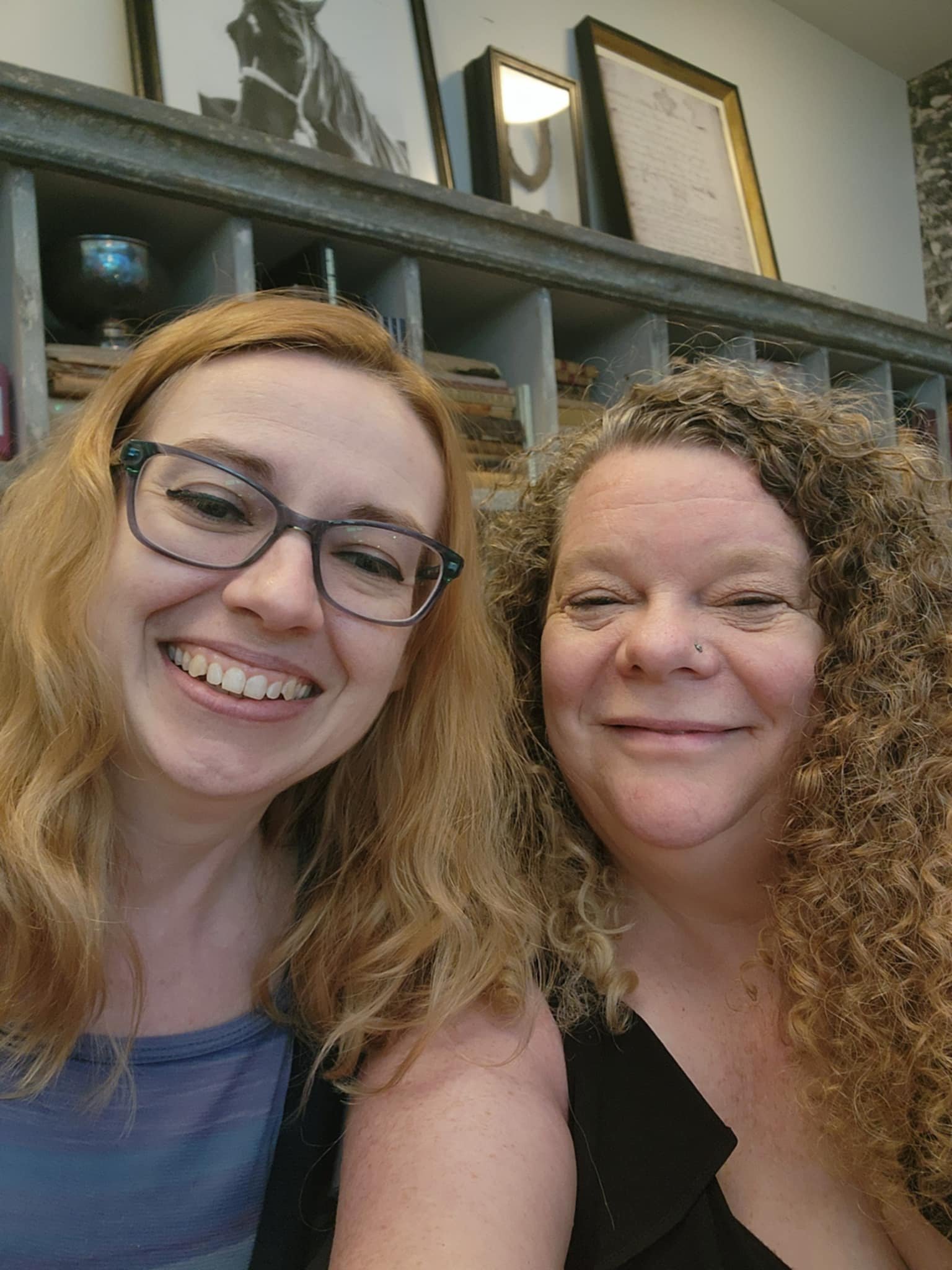
My Bestie Brie-Anna Willey from Business for Nerds find her @https://www.businessfornerds.com/
I Have Work Besties — They Just Don’t All Live Here (well some do, but most don’t)
I have several work besties, and they live all over the country.
Some of them, I’ve never met in person — we found each other online through coaching programs, collaborations, or even social media threads that turned into real friendships.
Others are local — we’ve met for coffee now and then — but most of our connection happens online. We hop on Sunday Zoom calls, check in by voice note, and co-work in real time, from wherever we are.
These relationships? They’re real.
They’re intentional.
And they’re saving me from burnout.
I Was Afraid Going Online Would Be Lonely
As a therapist, I need connection with others who understand what this work takes — emotionally, mentally, energetically.
I used to think working online would strip that away. That I'd be trading connection for convenience. But then I watched my kids build real friendships online — deep, trusting ones. They’d laugh, support each other, and build community in Minecraft or Discord the way I used to at lunch tables and break rooms.
And I thought… why not me?
Online Friendships Can Be Deeper Than In-Person Ones
And honestly? I prefer these relationships to many I had in past in-person jobs.
Back then, we connected mostly because we showed up at the same office. Now, my work besties are people I chose. People who chose me.
We make time to meet — not because we’re forced into the same break room — but because we value each other’s support. We bounce around ideas, talk marketing and mindset, cry, laugh, vent, and get each other through the weirdness that is online entrepreneurship.
They’ve seen me in every state:
Polished and put-together before a presentation
Disheveled and under-caffeinated on a Sunday brainstorm call
Fragile after a tough week with clients
Buzzing with excitement after a big win
These people get me — my work, my energy, my mission. They challenge me…to grow, confront my fears, to TALK about my money challenges.
Neurodivergent Folks Often Prefer This Way of Connecting
I work with many neurodivergent and highly sensitive women, and let me tell you — this kind of connection works for us.
We don’t always thrive in noisy mixers or drop-in groups full of surface-level small talk, it’s exhausting and often feels like we are pushing against our natural desire to go deep fast. We CAN do it, it just leaves us depleted and takes a lot of our spoons.
We like the slow burn of connection — repetitive, intentional interactions that help us decide if someone is safe, aligned, consistent.
And when we do connect around shared goals or mutual understanding?
We skip the water cooler and dive into the deep end.
So Yes — I Have Work Besties
I never imagined going online would grow my sense of community. But it did.
My work besties are a lifeline. A mirror. A brain trust. A nervous system regulation squad.
If you’re thinking about going online — whether as a therapist, coach, healer, or creative — I want you to know that isolation doesn’t have to be your fate.
With a little intention, you can build the community you need.
You can find your people.
You can create meaningful connection — even from your kitchen table in pajama pants.
One More Thing
If you’re sitting in your home office wondering if you’ll ever find your people, consider this your nudge.
✨ Start a conversation.
💛 Join that group.
🌱 Say hi to someone new at the next Zoom event.
Your future work bestie might be one message away.
Frequently Asked Questions
Can online work friendships be as meaningful as in-person friendships?
Absolutely. Meaningful friendships are built through trust, consistency, vulnerability, and shared experiences, not physical proximity. Many people find that online friendships become just as deep, and sometimes even deeper, because they're based on shared values and intentional connection rather than simply working in the same building.
Why do online friendships feel easier for some neurodivergent people?
Many neurodivergent people prefer connection that develops gradually through shared interests and repeated interactions. Online spaces often reduce the pressure of loud environments, small talk, and social expectations, making it easier to build authentic relationships at a comfortable pace. Rather than being forced into conversations because of proximity, online friendships often grow because of shared interests, mutual respect, and genuine choice.
Can working from home lead to isolation?
It can, but it doesn't have to. Working remotely requires being intentional about creating community. Joining professional groups, attending virtual networking events, participating in mastermind groups, scheduling coworking sessions, or simply checking in with colleagues can all help reduce isolation and build meaningful connection.
How can I make friends while working remotely?
Start by participating in communities centered around your interests or profession. Join Facebook groups, attend virtual events, participate in coaching programs, comment on posts, or simply reach out to someone whose work resonates with you. Many lasting friendships begin with one genuine conversation.
Are online friendships "real" friendships?
Absolutely. Research has shown that online friendships can provide emotional support, belonging, and meaningful connection comparable to in-person relationships. Like any friendship, what matters most is trust, consistency, vulnerability, and showing up for one another over time.
I'm highly sensitive and networking events exhaust me. What are other ways to meet people?
Many highly sensitive and neurodivergent people find they connect more naturally through smaller communities, shared interests, coworking sessions, book clubs, mastermind groups, online classes, or ongoing programs where relationships have time to develop naturally. You don't have to force yourself into environments that leave you depleted in order to build meaningful friendships.
Can online friendships help prevent burnout?
For many therapists, entrepreneurs, coaches, creatives, and remote professionals, yes. Having trusted colleagues to celebrate successes, process challenges, exchange ideas, and remind you that you're not alone can reduce isolation and become an important source of emotional support. Sometimes a quick Zoom call with someone who understands your work is exactly what your nervous system needs.
What if I'm naturally introverted?
Being introverted doesn't mean you don't need connection. It often means you prefer fewer, deeper relationships over frequent social interaction. Online communities can make it easier to build those relationships in ways that feel authentic, intentional, and sustainable.
Is it okay if my closest work friends live across the country?
Absolutely. Friendship isn't measured by geography. It's measured by trust, authenticity, and the willingness to show up for one another. Some of the deepest relationships are built not because people share an office, but because they share values, encourage one another's growth, and intentionally choose to stay connected. In many ways, those relationships can become even stronger because they're built on who you are, not simply where you work
How do I know I've found "my people?"
For me, it's less about finding people who agree with everything I say and more about finding people who make it safe to be fully myself. The right people challenge me, celebrate my wins, support me through setbacks, and leave me feeling energized rather than depleted. You don't have to settle for relationships built on convenience. Sometimes the people who understand you best are the ones you intentionally choose, no matter where they live.
Is it normal to feel guilty for preferring online friendships?
Yes. Many people have been taught that "real" friendships have to happen in person. But meaningful relationships are built through mutual care, consistency, and emotional safety, not zip codes. If your online friendships leave you feeling more connected, understood, and supported than many of your in-person relationships, there's nothing wrong with embracing that.
Can online friendships improve mental health?
They can. Feeling understood, supported, and connected is one of the strongest protective factors for emotional well-being. While online friendships aren't a replacement for professional mental health care when it's needed, they can reduce loneliness, provide encouragement, and remind us that we're not navigating life or work alone.
❤️ Final Thought
Whether your work besties live next door or across the country, meaningful relationships are built intentionally. Sometimes the people who help us grow, laugh, challenge us, and remind us who we are aren't sitting in the next office. They're one message, one Zoom call, or one "I saw your post and just wanted to say hi" away.
Because belonging isn't about proximity.
It's about finding people who feel like home.

Do Therapists Think About Their Clients? The Peculiar Bonds of Healing
Being a therapist is an intricate journey, where the tapestry of emotions unfolds in ways that often defy explanation. We dwell with individuals at their most vulnerable, witnessing the ebb and flow of their struggles and triumphs. The narratives shared in the therapy room cut deeper than those in conventional relationships, revealing intimate details that seldom see the light of day. Yet, within this authenticity, a subtle power differential exists – a nuanced dance between presence and disclosure, all orchestrated to benefit the client. 🎭💖
Grief Trigger warning
Many people quietly wonder whether their therapist ever thinks about them outside the therapy hour. They wonder whether the connection they feel in the room continues beyond the session.
Therapy Is a Relationship Unlike Any Other
Being a therapist is a strange and meaningful profession. We sit with people at their most vulnerable moments and witness the quiet unfolding of their struggles and triumphs. It is a place where the tapestry of emotions unfolds in ways that often defy explanation and is frequently unnatural in the real world. We dwell with individuals at their most vulnerable, witnessing the ebb and flow of their struggles and triumphs. The stories shared in the therapy room cut deeper than those in conventional relationships, revealing intimate details that seldom see the light of day. We see the real human….messy, raw, complicated, and indescribably beautiful Yet, within this authenticity, a subtle power differential exists – a nuanced dance between presence and disclosure, all orchestrated to benefit you, my client. 🎭💖
Caring Deeply While Holding Professional Boundaries
In this peculiar profession, the paradox is palpable. I am here to care deeply about you but must navigate the boundaries carefully, ensuring I don't overstep. The role extends beyond the therapy hour; I root for you, cheer you on, and find myself shedding tears when life throws challenges your way. Despite these emotional investments, it's crucial to remember that, in the end, I am not your friend. The struggle emerges when thoughts of you linger between sessions, prompting an internal debate about sharing a meme or initiating a casual greeting if our paths cross in public. Professional ethics, however, dictate that I cannot. I must always default to your lead, urging me to wait for you to make the first move. 🤔🤝
These relationships formed in the sanctuary of therapy are sometimes exclusive, and shared only by the two individuals involved. As time progresses, clients may naturally drift away, and despite the deep connections forged, we often lose touch.
Yet, the paradox persists: the therapeutic relationship is a relationship nonetheless. My clients touch my life as profoundly as I touch theirs, forming an emotional bond that transcends the realm of financial transactions. 💼💓
The Clients Who Stay With Us
As the years pass, reflections inevitably emerge about those who have woven through my professional journey, leaving a lasting impact. Did my time with them make a meaningful difference? Did their lives change for the better? Some clients pass through swiftly, their details fading from memory like fragments of a dream, but others, those forever imprinted in my heart, stay with me, becoming an indelible part of my own narrative. 📅📝
When a Former Client Passes Away
Thinking back to my early career as a school guidance counselor, I remember the "kiddos" who, even in adulthood, still hold a significant place in my heart. Today, the news of one of these forever kiddos passing reached me. It's a peculiar experience to witness the child you once knew grow into an adult, and you can't help but hope they are navigating the complexities of adulthood with resilience. The passing of a client prompts a cascade of questions about the impact I've had – did it matter? Did I genuinely help them along their journey? Did they know how deeply they were loved and supported? 🌟❤️
Today, the weight of emotions manifested in freely flowing tears, and a part of my heart broke. Not because my life is destined for a drastic change, but because, as a fellow human, I bid farewell to someone cherished. Someone I loved. A fellow life traveler, I was fortunate enough to guide. When you wonder if your therapist thinks of you between sessions, the resounding answer is yes. We think of you, root for you, and even shed tears long after our official time together ends. As therapists, we navigate the intricacies of our clients' lives, hoping that, in some meaningful way, we contributed to positive change. 🌈💔
Therapy relationships are professional and still deeply human. So, if you’ve ever wondered whether your therapist thinks of you after sessions end, the answer is yes. Many of us carry our clients in our hearts long after the therapy hour is over.⏰ ❤️
Questions People Often Ask About the Therapy Relationship
Do therapists think about their clients between sessions?
Yes. Many therapists naturally reflect on their clients between sessions, especially when preparing for future work together. While therapists maintain professional boundaries, the people they work with often stay on their minds as they hope for their growth and healing.
Why can’t therapists say hello first in public?
Therapists are trained to protect client privacy. If we greeted a client first in public, it could unintentionally reveal that the person is in therapy. Because of this, therapists usually wait for the client to acknowledge them first.
Do therapists care about their clients?
Yes. Healthy therapy involves genuine care and compassion. Therapists are trained to balance empathy with professional boundaries so they can support clients effectively without the relationship becoming confusing or harmful.
Do therapists remember their clients after therapy ends?
Often, yes. Some clients fade from memory over time, but many remain meaningful parts of a therapist’s professional journey. The work done together can leave a lasting impression on both people involved.
Considering Therapy?
Therapy relationships are unique spaces where trust, vulnerability, and healing can unfold over time. If you're looking for support with burnout, sensitivity, trauma, or life transitions, you can learn more about my approach to therapy here:

Vulnerability in the Counseling setting
I want to talk with you about what it is like to be vulnerable when you come into a counselor's office. A lot of people when they come in for the first time, may have not even sought out help before, or may have been struggling seeing someone but they weren't the right fit. A lot of times they have experienced that pain of rejection by other people as well. So coming in and talking to someone about your deepest secrets can often be difficult.
So how is a counselor different from just having a friend? A counselor is capable of looking at things from a non-harsh point and can help you see things from a clearer vision. It is often difficult to be vulnerable with that person because they are essentially a total stranger. The good news is that most counselors have sat on that side of the couch as well and should be able to help you talk about stuff that is extremely difficult and maybe even painful.
Now, does this come easily and quickly? Sometimes it doesn't, and that is not unusual. I have worked with clients for a long time and they will still say "I was afraid to share that with you because I was afraid that you might judge me or make a mean comment about it." The thing about a really good counselor is they are not there to judge you. They are there to help you resolve whatever issues might be happening. The vulnerability piece is definitely difficult but our job is to help you figure out what the pain is that you're experiencing and then help you work through the pain
It is not unusual for people to hang on to things like sexual abuse for a long time and when you approach that subject a client may pull back and say "I’m not ready to deal with that." If you are that patient that is not ready to deal with it, your counselor should give you the space and say "okay we're not going to deal with that right now but we'll come back to it.”
Vulnerability is tough for most people but when you're going into a counselor, don't think that they expect you to give all of your deepest darkest secrets immediately. We are also human beings and we recognize that some things are just too painful to share. However, we also know that if you share it we can work on the healing process. When you get to the other side, you are going to feel a lot better.
Now, knowing a little about the healing process, it is often relieving when you first start sharing your information. If you think about the therapy process as being in a tunnel, when you first go in you might see a little bit of light, but the further you go in the tunnel the darker it may get. Sometimes it gets darker before you see the light again, so expect that when going into the therapy process. Your counselor is there to be with you every step of the way as you're going through that process and opening yourself up.
As a therapist, I know it's hard and I understand how difficult vulnerability can be, however I also know that if you work through the process, there is so much healing on the other end.
My suggestion to you would be to find a therapist that you really trust, and open up to them because they are here to help you heal. I hope this helps! If you've been having some doubts about whether or not you can share something with your therapist and if you have been holding things in, please reach out to them. They are there for you!
If you would like to work with me, visit the “New Patient Registration” link to get started!